


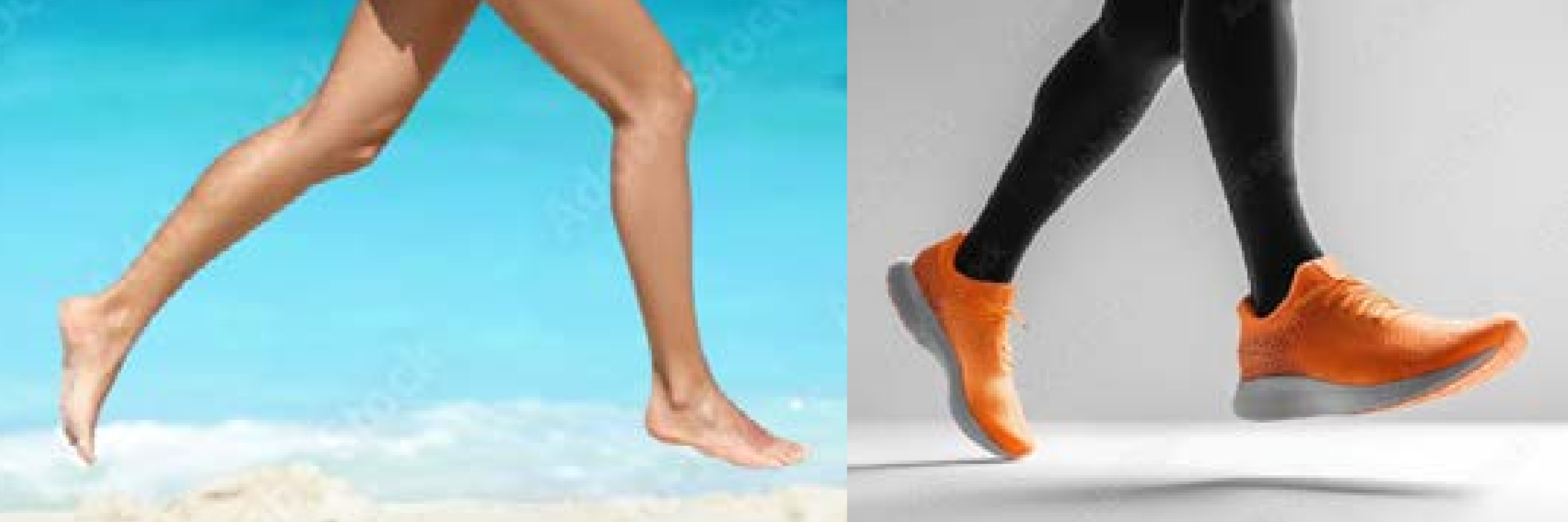
HOW MODERN FOOTWEAR MAY BE CONTRIBUTING TO OUR JOINT PAIN EPIDEMIC
Rethinking Shoes, Gait, and the Health of Our Knees, Hips, and Spine
Most people give little thought to their feet—until something hurts. We confine them in shoes that are:
-
Too narrow (compressing the forefoot and limiting toe splay)
-
Too soft (dulling proprioceptive input and promoting instability)
-
Too elevated at the heel (shifting weight forward and altering posture)
-
Over-supported with arch inserts (weakening the intrinsic muscles that form the arch)
Think of walking on soft, raised soles with arch supports as walking on Bosu balls in ski boots. Yet your feet are not passive slabs. They are sophisticated sensory-motor systems designed to dynamically interact with the world. And when you compromise the base, everything above it must compensate.
Weak Feet, Weak Links: What the Evidence Says
Research has increasingly shown that dysfunction in the foot can lead to pain and breakdowns higher up the kinetic chain.
Knee Pain:
Overpronation and flattened arches increase tibial internal rotation, stressing the patellofemoral joint. Barton et al., 2010: Foot posture abnormalities predict patellofemoral pain.
Hip Pain:
Foot instability overloads hip abductors and disrupts femoral alignment. Powers et al., 2002: Abnormal foot mechanics alter hip kinematics during gait.
Low Back Pain:
Asymmetrical foot loading affects pelvic tilt and lumbar alignment. Brantingham et al., 2006: Orthotics can reduce low back pain by addressing foot-origin discrepancies.
An Evolutionary Design, Sabotaged
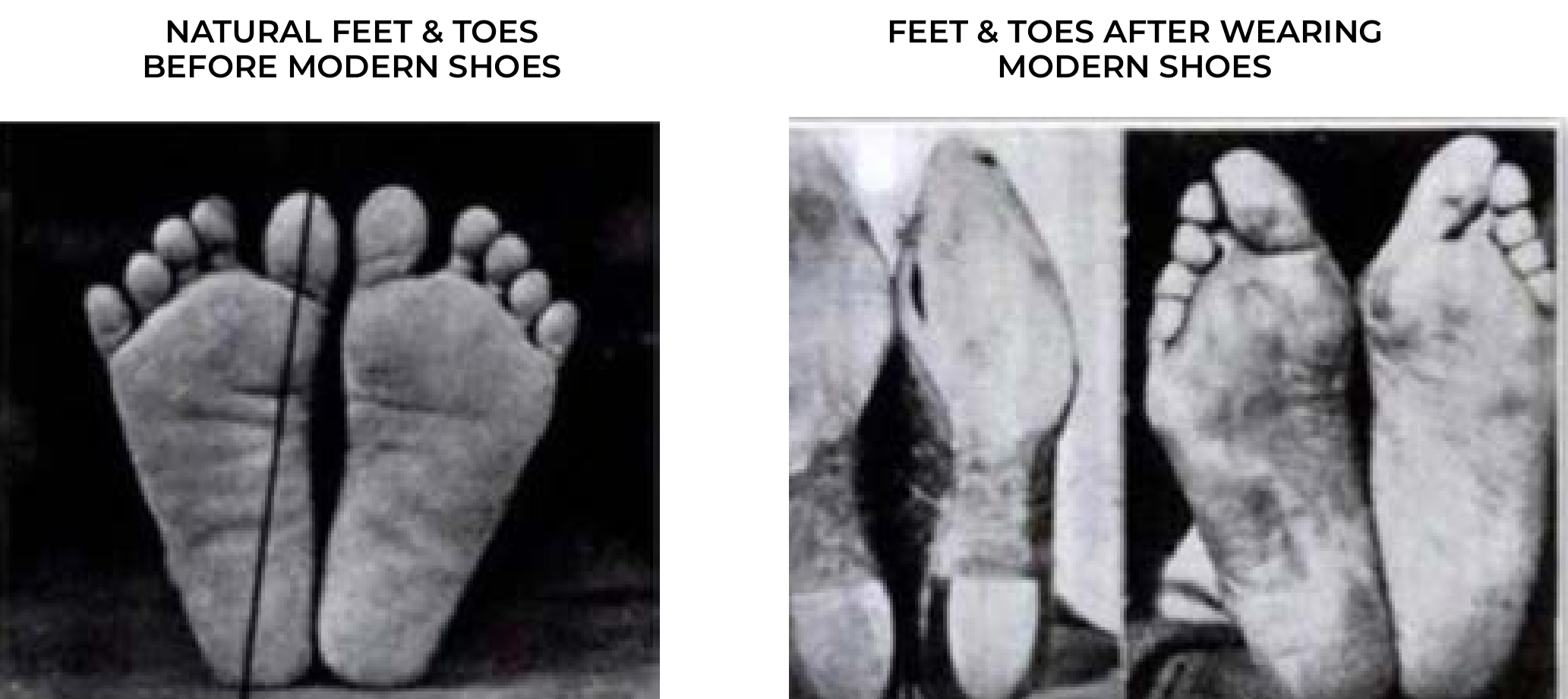
The foot is the product of millions of years of refinement. Human beings evolved walking barefoot or in minimal footwear—thin, flexible sandals or moccasins. These allowed:
-
Wide toe splay
-
Sensory input from the ground
-
Strong arches and ankle stability
-
A spring-loaded forefoot strike gait
Modern shoes changed all of that. What began in the 1970s as a well-intentioned innovation—cushioned soles, arch support, and heel elevation—turned into a global experiment. And the results are now in: we are seeing more knee, hip, and back problems than ever before.
The Tarahumara: Proof in Simplicity
The Tarahumara (Rarámuri) of Mexico are known for ultra-endurance running in zero-drop, tire-tread huarache sandals. Their feet are strong, arches natural, and their stride is low-impact.
Historically, they showed almost no signs of arthritis or joint degeneration, even with advanced age and high mileage.
But as Western foods and modern comforts reached their communities, something changed:
-
Processed food intake increased
-
Body composition shifted
-
And knee arthritis, once rare, began to appear
Same genetics, same activity level, but different inputs.
The Power of the Foot
Many underestimate the capability of the human foot.
Yet some born without hands have trained their feet to:
-
Paint, play instruments, or perform surgery
-
Drive cars or fly airplanes
-
Type, text, or even thread a needle
If our feet are capable of such dexterity, why can’t they be trusted to simply support us?
They can. But like any other part of the body, they must be trained.
The Biomechanics of the Modern Shoe
Modern shoes encourage a heel-strike gait. Thick soles and heel lifts change how the foot meets the ground.
Compared to a forefoot strike:
-
Heel strike creates a vertical impact spike
-
Increases loading on the knee and patellofemoral joint
-
Decreases muscular shock absorption in the calves and feet
Timeline of Consequences:
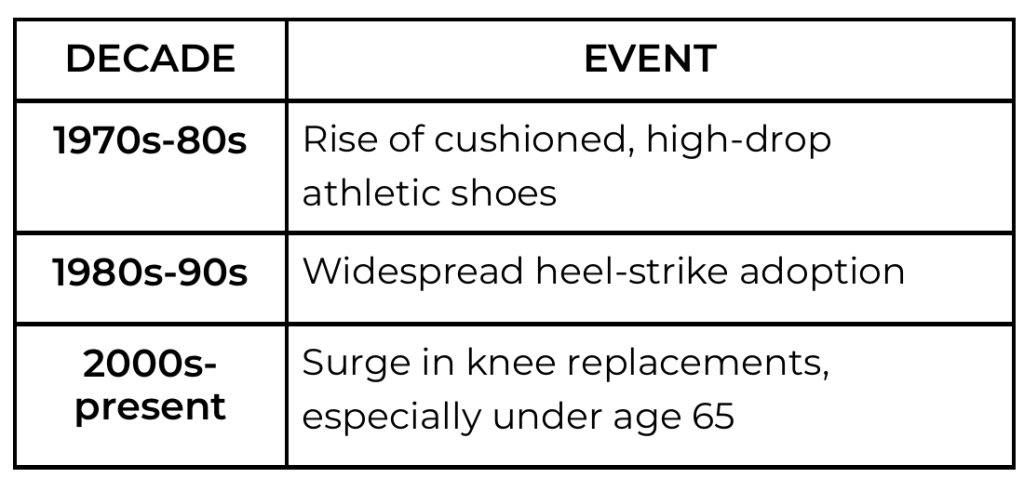
Supporting Data:
-
Kulmala et al., 2013: Heel striking increases patellofemoral joint stress
-
Lieberman et al., 2010: Forefoot strike in barefoot runners avoids high impact transients
-
AAOS: Total knee replacements rose 120% from 2000 to 2010
A Lesson in Hormesis
Hormesis is the idea that small doses of stress build resilience.
Imagine putting neck braces on infants to protect their fragile cervical spines—then insisting they wear them for life.
The result? Weak necks, stunted development, and dysfunction.This is what we’ve done to the feet.
By shielding them from load, movement, and sensory feedback, we’ve made them dependent, weak, and unreliable.But the good news is: the foot can be reconditioned.
My Journey: From Orthotics to the Rim of the Canyon
I prescribed orthotics for over 20 years. I wore high-drop, cushioned athletic shoes with arch support.
I believed I was doing what was best for my feet—and for my patients.But gradually, I questioned what I saw. Despite all the support, people weren’t getting stronger.
Their pain was being managed, not resolved.So I began my own transition:
-
Walking barefoot more often
-
Lowering heel drop over time
-
Strengthening foot and calf musculature
-
Relearning how to land midfoot and absorb shock
It took years. My Achilles were stubborn. But they adapted.
The culmination?
A rim-to-river-to-rim hike in the Grand Canyon in a single day, wearing minimalist shoes so thin we joked they were “ballet slippers.”
I carried 30 pounds of supplies and over 200 ounces of water for the group.
Minimal pain. No injury. Strong, stable movement.I hadn’t just changed my shoes. I had rebuilt my foundation.
And with it, my body became more resilient.Lessons From a Headline: What I Almost Missed
I was first intrigued by the minimalist shoe concept in 2013.
I bought a pair of Vibram FiveFingers and began the slow process of adaptation.Not long after, I saw the headline:
“Vibram Settles for Millions Over Claims Their Shoes Strengthen Feet.”I didn’t investigate the details. I assumed the lawsuit was proof the concept didn’t work.
I shelved my Vibrams, dismissing them as a passing fad.It wasn’t until 2021 that I revisited the idea and discovered the truth:
-
The lawsuit was about marketing claims, not the design itself.
-
The injury resulted from someone skipping the adaptation phase—reportedly running a 10K or half marathon shortly after switching to minimalist shoes, well before their feet had time to adapt.
-
The science of strengthening through use still held true.
That moment taught me a lesson I now carry into all areas of health:
Never base decisions on a headline. Always dig for the full story.A Family Affair: Generational Change
My wife joined me in this minimalist shoe experiment.
She was so impressed by the noticeable improvement in foot strength that she encouraged her parents to try as well.In their mid-70s, I cautioned them to transition slowly.
Her father was close to needing a hip replacement, and her mother struggled with chronic knee pain.To my surprise, they adapted more quickly than expected.
Over time, both experienced significant improvement.
Her father’s hip pain receded, and her mother’s knee pain disappeared.Then one day, during her usual walk, her mother’s knee pain suddenly returned mid-stride.
She looked down and realized she had accidentally worn her old tennis shoes.
That was the last time she wore raised-heel, cushioned, arch-supported shoes.Their experience only reinforced what I had seen in myself and my patients:
When the foot is allowed to function naturally, the rest of the body begins to heal.Patient Takeaways: How to Begin Strengthening Your Foundation
Transitioning to barefoot or minimalist footwear is a powerful way to reclaim the strength and adaptability of your feet—but it must be done gradually and with respect for how under-trained most feet have become.
Start Here:
-
Wear minimalist shoes intermittently
Begin with short errands or indoor wear, gradually increasing time over weeks or months. -
Go barefoot at home
Let your feet feel the floor. Hard, flat surfaces are fine in short doses. -
Strengthen your calves
Include eccentric heel drops, toe walking, and loaded calf raises in your routine. -
Stretch and mobilize
Foam roll your calves, stretch your Achilles, and do ankle mobility work. -
Expect soreness
Achilles tightness and mild calf strain are common during the transition. -
Use toe spacers
Help reestablish proper toe alignment and splay. -
Practice toe control
Try lifting and spreading your toes; build toward isolating the big toe. -
Train the arch
Do short foot exercises, doming, and towel scrunches to wake up the medial arch.Consistency over months, not days, is key.
The payoff? Stronger feet, improved balance, better gait, and possibly relief from chronic joint pain you’ve been told is “just part of aging.”References
-
Barton CJ, Bonanno D, Menz HB. Foot and ankle characteristics in patellofemoral pain syndrome: a case-control and reliability study. Br J Sports Med. 2010;44(9):683–688.
-
Powers CM. The influence of abnormal hip mechanics on knee injury: a biomechanical perspective. J Orthop Sports Phys Ther. 2010;40(2):42–51.
-
Brantingham JW, et al. Effectiveness of manual therapies: the UK evidence report. J Manipulative Physiol Ther. 2006;29(3):157–163.
-
Kulmala JP, et al. Forefoot strikers exhibit lower running-induced knee loading than rearfoot strikers. Med Sci Sports Exerc. 2013;45(12):2306–2313.
-
Lieberman DE, et al. Foot strike patterns and collision forces in habitually barefoot vs. shod runners. Nature. 2010;463(7280):531–535.
-
American Academy of Orthopaedic Surgeons (AAOS). Total knee replacements projected to grow 673% by 2030. AAOS Newsroom
-
Bezdek v. Vibram USA Inc. Settlement documentation. Case No. 1:12-cv-10513 (D. Mass., 2014)
-
-