Pain ratings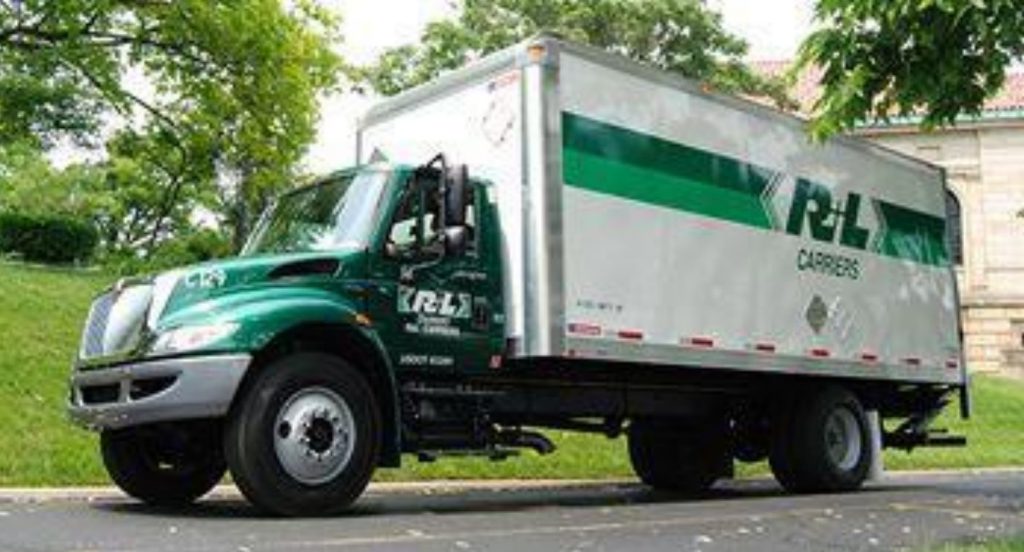
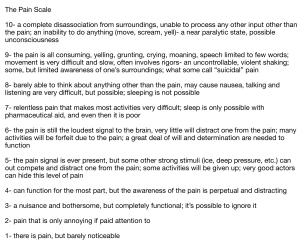
Being hit by a freight truck traveling 60 mph= 10
Chest tube insertion= a brief 9
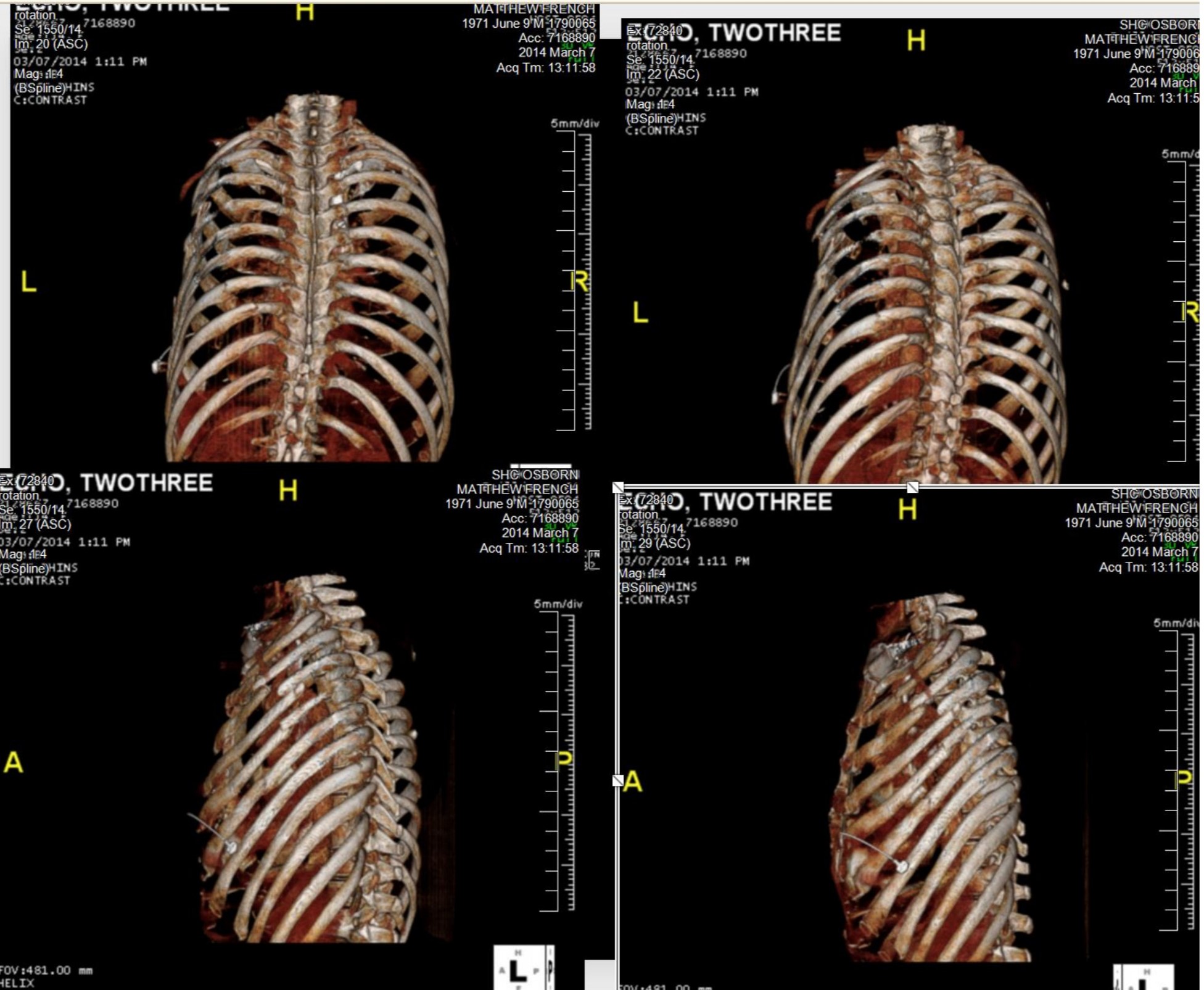
Flail chest= 7-8 with heavy opiates; 9 when I had to be moved
Aftermath of rib plating surgery= 10; 7 the next day
3-07-2014
We’ve all heard the phrase, “I feel like I’ve been hit by a truck.” I’m about to tell you, you probably don’t.
It was a gorgeous sunny afternoon when my wife and I set out for our final big training ride before a series of upcoming races. In our tandem, we were a force to be reckoned with. But not against a 26’ box truck. At mile 67 of our planned 87-mile ride, we were side-swiped by this behemoth, traveling at highway speeds. The edge of the trailer struck my left shoulder and ribcage, sending us crashing to the ground. My wife suffered large patches of road rash on her right hip, back, and shoulder from making contact with the pavement at 27 mph. But my left side was far worse: broken scapula, elbow, three vertebrae, ribs 2-9, and a punctured lung. From being in the best physical shape of my life, I became an unconscious bag of broken bones in an instant.
I have a vague memory of being swallowed up by a freight train. The next clear recollection is being lifted onto a gurney. Like a cattle prod during a nap, the extreme pain of being lifted shocked me back into consciousness. The paramedics told me, “Hang in there, we’re starting a fentanyl IV.” The wave of intense opiates reduced the pain just enough to allow me to speak, and I began giving the paramedics an inventory of my suspected injuries (which turned out to be quite accurate). They remarked, “You obviously work in healthcare!”
3-07/08/14 ICU
A trendy buzzword these days is “present time consciousness.” In those days in the ICU, my mind was so consumed with pain that there was little bandwidth left for anything past or future. If someone yells loudly enough into your ear, it becomes impossible to hear anything else. It was literally one breath at a time.
I had an On-Q pain pump inserted. The process began with alcohol swabs being used to disinfect the fresh, skinless road rash on my back. Then, an 8″ needle was inserted along my thoracic spine. The procedure itself exacerbated my pain, and I never felt any pain relief from the pump. A nurse later told me that On-Q reps had aggressively promoted the device, but she wasn’t seeing any improvements among patients.
For the next couple of days, whenever I had to be moved in bed, I could hear the displaced bone fragments in my rib cage clicking and crunching. Every single breath felt like being stabbed in the chest. This worsened at night, and I involuntarily moaned with each breath. I couldn’t sleep more than 15 minutes at a time because the automated blood pressure cuff would inflate at ridiculously high pressures, sometimes getting stuck and forcing me to frantically push my call button.
And then came the opiates. I was on considerable doses those first few days, and I can see how easy it is to be lured by them. They helped put my mind in a place that said, “everything will be fine,” essentially melting away any stress or anxiety about my future. This wasn’t my first rodeo with opiates, and fortunately, I hadn’t fallen prey to their seduction yet. In severe trauma, pain starts out intense and then improves day by day, allowing for a parallel reduction in dose.
3-09-14
On the third day, I was moved from the ICU to a standard room. My roommate, who was there for orbital fractures, was loud and vulgar, either farting or screaming and swearing at “his woman” on the phone. We were about arm’s length apart with only a thin curtain separating us. I was feeling paranoid, unable to stop moaning with every breath. Nighttime always seemed worse. I feared he might get annoyed and punch me, and I was completely incapable of defending myself. Thank God he was discharged after a couple of long hours.
That afternoon, the nurses asked if I wanted to try getting up for the first time. I needed to go to the bathroom, and, being eager for a challenge, I didn’t hesitate to say yes. But before I could get to my feet, it was discovered I was lying in a pool of my own blood. Apparently, the chest tube wasn’t sealed properly, and I was bleeding out around it. Going to the bathroom would have to wait.
3-10-14
On Monday morning, my smashed iPhone began ringing repeatedly. It was the final month of the build-out for the new building I had purchased for my practice. We had set an opening date for April 7, 2014, and my general contractor was trying to reach me for final touch-ups. Word eventually got to him about my current state, and he finished the project without my input.
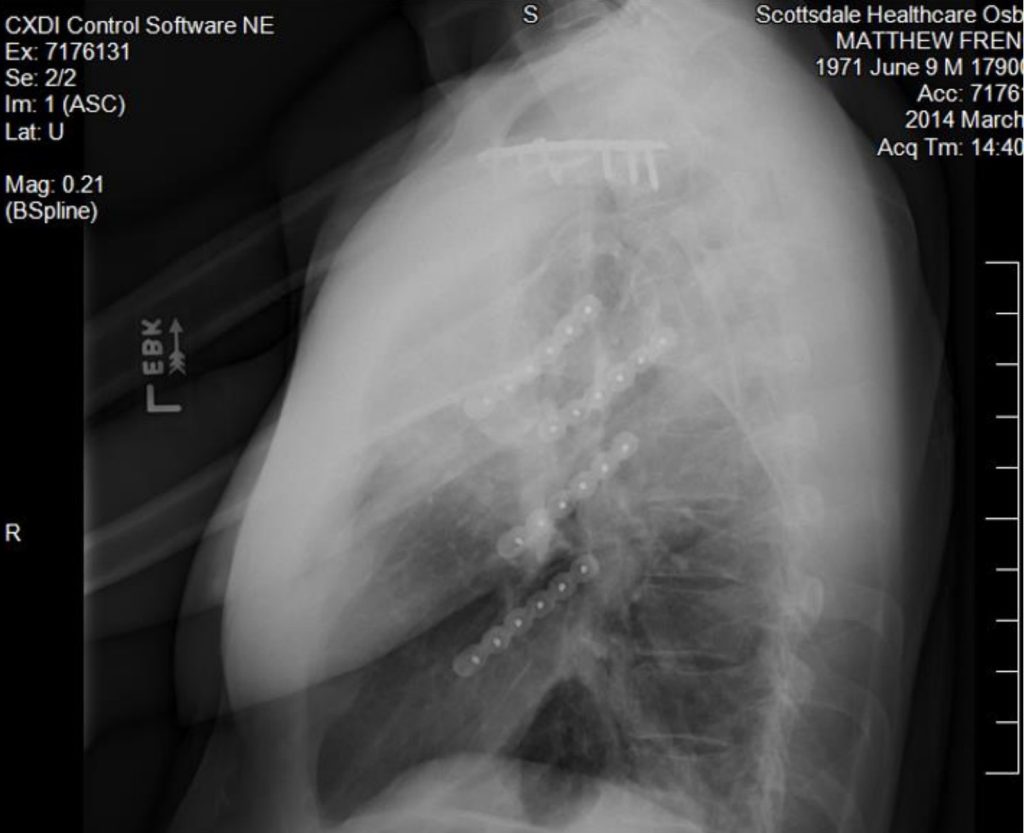
Later, I learned that the hospital staff referred to the week I was there as the “week from hell.” They had just switched to a new EHR system, and the glitches and crashes were continuous. One such glitch affected me directly. On 3-10, I had four of my broken ribs surgically pieced back together with four titanium plates and 24 screws. Rib plating was a new procedure, only used since 2012. When I woke up from surgery, I thought I had woken up during the procedure because the pain was exactly the same. The EHR glitch had removed all pain medication from my chart. I had previously been on heavy pain management, even with a morphine pump that I could control. After surgery—nothing.
The pain was indescribable—a medieval torture chamber, feeling like my chest had been sliced open by a sword. It was a hot, stinging, acid-like pain with nowhere left to go for intensity. I don’t think there was anything anyone could have done to make it hurt any more. I begged my nurse for help, and she replied, “All I can give you is baby aspirin.” I endured this agony for about five hours, barely able to breathe and slipping in and out of consciousness. My wife said my eyes would roll up, and I would become unresponsive for brief periods. She frantically texted a nurse friend of hers at the hospital. When her shift ended, she came straight to my room and quickly realized the situation. She camped out by the operating room of the surgeon who had plated my ribs and waited for her to finish the next surgery. The surgeon exclaimed, “Why on earth are you the one telling me this?” Obviously, she was dismayed that a nurse from a different wing was addressing the issue. The surgeon rushed to my room and apologized profusely. By that point, I was so deep in the pain cave that it took high-dose dilaudid before I could even bear to breathe again. Had I been alone without an advocate (my wife), I don’t think I would have survived that night.
3-11-14–14
By the 11th, I longed for the ordinary—the regular, routine “boring” days of my life before this nightmare. Nothing brings gratitude better than deprivation. Once the pain was more tolerable, I finally felt the road to recovery could begin. Having my ribs pieced back together made it easier to breathe and move without the horrifying sound of bone fragments clicking in my ribcage.
I found that hospital food was far from ideal for recovery. My wife smuggled in my usual breakfast smoothies, packed with added protein and colostrum. She also brought in stronger coffee, since hospital coffee was weak. This helped with the infamous hospital-induced constipation caused by heavy pain meds, anesthesia, and lack of movement. I also asked what supplements I could get from the hospital pharmacy, and was allowed a multivitamin, calcium, probiotic, and vitamin D—essential for bone recovery.
When the hospital staff saw my rapid improvement, they were amazed. When I was told to try taking a few steps, I walked ten. On 3-14, my chest tube was removed, and I walked laps around the hospital corridor. That day, I was discharged.
Home and the Return to Work
We had wonderful support from family and friends. Family members took shifts flying in from out of town shortly after hearing I was in ICU. For the first three weeks at home, church and cycling friends brought us meals every night. It took a month before I could tolerate lying down, so I had to sleep in a Lazy Boy chair during that time.
Now that the pain was less extreme, I could focus and worry on life’s stresses. Being self-employed meant that when I wasn’t working, I wasn’t earning. The timing couldn’t have been worse. I had just assumed considerable debt purchasing and building out my new clinic space, and I had two children to feed. After being forced out of work from a prior accident in 2009, many patients had migrated to other clinics, so my motivation to return was sky-high. When I asked a doctor if I could get back to work within a month, she laughed, thinking I was joking. When she saw I wasn’t, she replied, “It wouldn’t be possible.” So, when I returned to seeing patients full time exactly one month after the collision, I wasn’t technically going against doctor’s orders.
The First Ride Back
I began very light exercise on an indoor bike about a week after being home. This forced me to breathe deeply, which my damaged ribcage and punctured lung needed. But trying to inhale with any depth was painful, bringing that dagger back into my chest. After my first ride, I coughed up large blood clots, which was unsettling. I contacted a surgeon friend who reassured me that it was old coagulated blood from the lung puncture—getting it out was a good thing.
On April 13, I did my first real ride outdoors with my cycling team. I surprised myself by completing all 50 miles and averaging 18 mph.
A Long Road Ahead
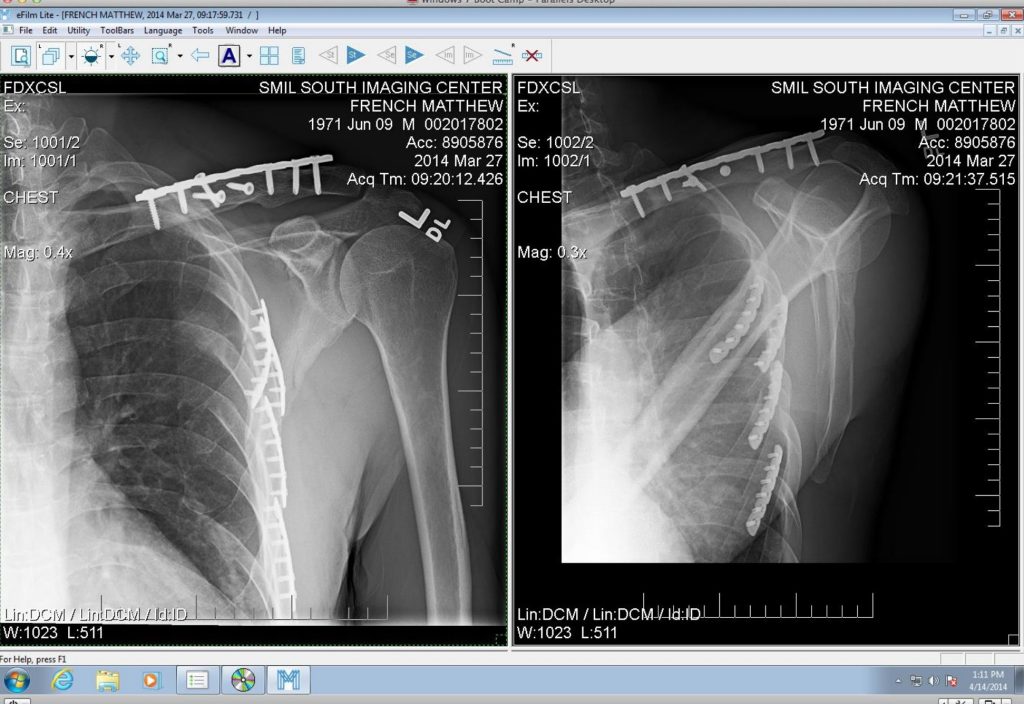
It took a long time before the pain was no longer a daily reminder. Many years later, the rib plates still get aggravated. In the summer of 2021, I tried surfing for the first time in Hawaii and discovered that lying on my stomach on the hard board caused terrible pain in the rib plates. As a result, my surfing career was limited to just one run. 11 years later, heavy bench pressing (at least for me) still makes the ribs hurt.
5-19-2014: An Unforeseen Complication
2014 was a “moderately severe” flu season, and it hit our household in early May. Each family member had their turn with fever, body aches, and bronchitis, and I was the last to catch it. I was pretty sick for about three days, then seemed to recover. But on May 19, after two relatively asymptomatic days, the illness returned with a vengeance.
I had never been that sick before, nor have I been since. I lay on the couch, violently shaking from chills, and asked my wife to check my temperature. It read 105°F. The last thing I wanted to do was go back to the hospital, but I had little choice.
The hospital, seeing me as just another melodramatic flu case, dismissed my concerns. I explained that I had the flu, but this felt different—I suspected it had progressed to pneumonia due to my recent punctured lung. They proceeded to shove the giant Q-tip up my nose for a flu test, which came back negative. But I did indeed have pneumonia, an opportunistic secondary infection that had settled into my weakened lung after the flu. The infection had even spread to a moderate degree of sepsis meaning that had I gone home as told, this could have been fatal. Though it had been 10 weeks since the ribs fractured, the coughing was terribly painful.
I was admitted, and made sure to ask for a private room. Over the next 24 hours, my condition worsened. This time, things were different. After the collision, each day my wife saw some improvement in my condition. But this time, every day I seemed to get worse. It was as if the rewind button on my recovery had been pushed.
Fortunately, by May 21, the IV antibiotics began to take effect, and I was released that evening, feeling better but reminded once again of the fragility of life.
Some lessons/advice
- If brought to the hospital from an accident, give verbal consent to treat rather than sign anything. When I arrived at the hospital with a concussion, collapsed lung, shattered ribcage and on a fentanyl IV, paperwork was shoved in my face and I was told to sign to give consent to treat. The paperwork was actually a lengthy legal document which covers a policy called ‘balanced billing’. My out of pocket (approx. $15,000) and insurance paid the insurance negotiated rate in full. If a settlement is involved, then the hospital wants its full inflated amount paid up. This was far more than the meager settlement in this case, so they demanded it all saying I signed an agreement to pay this. This practice is not legal for those on Medicare.
- Request a private room. This was not the first time I had a terrible hospital room mate.
- Be nice to the nurses. They deal with a lot of very unpleasant people. If you are not one of those people, they will return the appreciation for the most part.
 Have an advocate. When in such a bad physical state, one cannot advocate for themselves, and often has limited awareness of what is happening. If you don’t have a spouse, family member or close friend who can advocate for you, you can request one of the hospitals.